
Welcome to our health library. The information shared below is provided to you as an educational and informational source only and is not intended to replace a medical examination or consultation, or medical advice given to you by a physician or medical professional.
Knee problems can result from a structural weakness, overuse, or sudden injury. Or they can simply be a natural part of aging. Whatever the cause, knee problems are often successfully diagnosed and treated with arthroscopy, a technique that allows your doctor to see clearly inside your knee, using only small incisions.
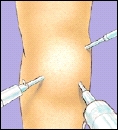
The arthroscope is an instrument used to look directly into joints. This makes it useful for both diagnosis and treatment. The arthroscope contains a pathway for fluids and coated glass fibers that beam an intense, cool light into the joint. A camera attached to the arthroscope allows your doctor to see a clear image of most areas of your knee joint on a monitor.
Risks and Complications As with similar surgeries, arthroscopy carries the risk of swelling and stiffness, bleeding, blood clots, infection, or continuing knee problems.

You may have lab tests before surgery, and you'll be asked not to eat or drink anything 10 hours before your surgery.
At the beginning of the procedure, you will receive an anesthetic. It will make you sleep (general anesthesia), numb you from the waist down (regional anesthesia), or just numb your knee (local anesthesia).
Then, your doctor makes a few incisions (portals) in your knee.
Sterile fluid is inserted through one portal or through the arthroscope to expand your knee joint. This makes it easier to see and work inside your joint.
Your doctor confirms the type and degree of knee damage, using the arthroscope.
Whenever possible, your doctor treats your knee during arthroscopy, using surgical instruments such as shavers or thermal devices.
Publication Source: American Academy of Orthopaedic Surgeons
Publication Source: Arthroscopy.com
Online Source: American Academy of Orthopaedic Surgeons
Online Source: Arthroscopy.com
Date Last Reviewed: 2007-01-15T00:00:00-07:00
Date Last Modified: 2000-11-01T00:00:00-06:00
For more information, call Dr. Walker at 972.392.3330 or use our Online Appointment Request Form today!