
Welcome to our health library. The information shared below is provided to you as an educational and informational source only and is not intended to replace a medical examination or consultation, or medical advice given to you by a physician or medical professional.
Certain repetitive hand activities may put you at higher risk for developing carpal tunnel syndrome (CTS). By learning how to modify the way you use your hands, you may be able to reduce the risk. Keep the tips listed below in mind at home and on the job. And, be sure to follow your company's hand and wrist safety policies and procedures.
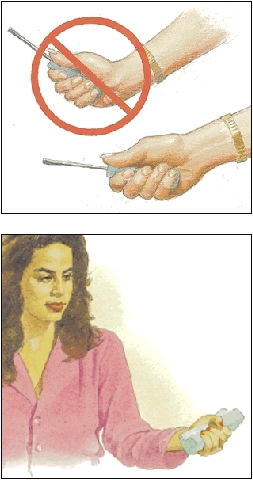
Avoid using your wrist in a bent (flexed), extended, or twisted position for long periods of time. Instead, try to maintain a neutral (straight) wrist position.
Gripping, grasping, or lifting with the thumb and index finger can put stress on your wrist. When practical, use the whole hand and all the fingers to grasp an object.
Even simple, light tasks may eventually cause injury. If possible, avoid repetitive movements or holding an object in the same way for extended periods of time.
Periodically give your hands a break by letting them rest briefly. Or you may be able to alternate easy and hard tasks, switch hands, or rotate work activities.
Reducing the speed with which you do a forceful, repetitive movement gives your wrist time to recover from the effort. Using power tools helps reduce the force.
Certain exercises strengthen the hand and arm muscles. They may help by reducing the need to compensate for these weak muscles with a poor wrist position.
Publication Source: National Institute of Neurological Disorders and Stroke
Online Source: National Institute of Neurological Disorders and Stroke
Date Last Reviewed: 2007-01-15T00:00:00-07:00
Date Last Modified: 2002-07-09T00:00:00-06:00
For more information, call Dr. Walker at 972.392.3330 or use our Online Appointment Request Form today!