
Welcome to our health library. The information shared below is provided to you as an educational and informational source only and is not intended to replace a medical examination or consultation, or medical advice given to you by a physician or medical professional.
The treatment is done in a hospital or surgery center. You'll be asked to fill out some forms, including a consent form. You may also be examined.
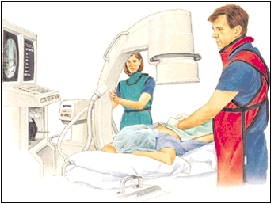
To help you relax, medication may be given through an IV (intravenous) line. You will lie on an exam table on your stomach, back, or side. This depends on where you will be injected. During your treatment:
The skin over the injection site is cleaned. A local anesthetic (pain medication) numbs the skin.
Fluoroscopy (x-ray imaging) may be used to help the doctor see your spine. If so, a contrast "dye" may be injected into the affected area.
The injection is given. It may contain including a local anesthetic to numb the region around the joint or steroids (medications that reduce inflammation).
Most often, you can go home in about an hour. Have an adult friend or relative drive you. The anesthetic wears off in a few hours. When it does, your back or neck may feel more sore than usual. This is normal. Take it easy for the rest of the day. The steroids most often begin to work in about 3-4 days. Your doctor can tell you when it's okay to go back to work.
Risks and complications are rare, but can include:
Infection
Bleeding
Prolonged increase in pain
Nerve damage (very rare)
Call your doctor if you have any of the following:
Severe headaches
Fever over 101.0F, chills, redness or drainage at the injection site
Weakness in your arms or legs
Date Last Reviewed:
Date Last Modified: 2002-07-09T08:39:48-06:00
For more information, call Dr. Walker at 972.392.3330 or use our Online Appointment Request Form today!
