
Welcome to our health library. The information shared below is provided to you as an educational and informational source only and is not intended to replace a medical examination or consultation, or medical advice given to you by a physician or medical professional.
The shoulder is your body's most flexible joint. It is designed to let the arm move in almost any direction. But this flexibility has a price-it makes the joint prone to injury. If you have a shoulder problem, a surgical procedure called arthroscopy can help.
Your doctor will ask you about your symptoms and the history of your shoulder problem. Your shoulder will be examined. And diagnostic tests, such as an x-ray or an MRI, may be done. These help your doctor find the cause of your shoulder problem.
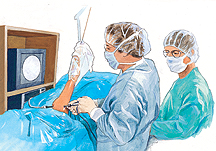
Arthroscopy allows your doctor to see and work inside your shoulder joint through small incisions. A long, thin, lighted instrument called an arthroscope is used. During surgery, the arthroscope sends live video images from inside the joint to a monitor. Using these images, the doctor can diagnose and treat your shoulder problem. Because arthroscopy uses much smaller incisions, recovery is often shorter and less painful than recovery after open surgery.
Stiffness or ongoing pain in your shoulder
Bleeding or blood clots
Infection
Damage to nerves or blood vessels
Publication Source: American Academy of Orthopaedic Surgeons
Online Source: American Academy of Orthopaedic Surgeons
Date Last Reviewed: 2007-01-15T00:00:00-07:00
Date Last Modified: 2005-04-05T00:00:00-06:00
For more information, call Dr. Walker at 972.392.3330 or use our Online Appointment Request Form today!